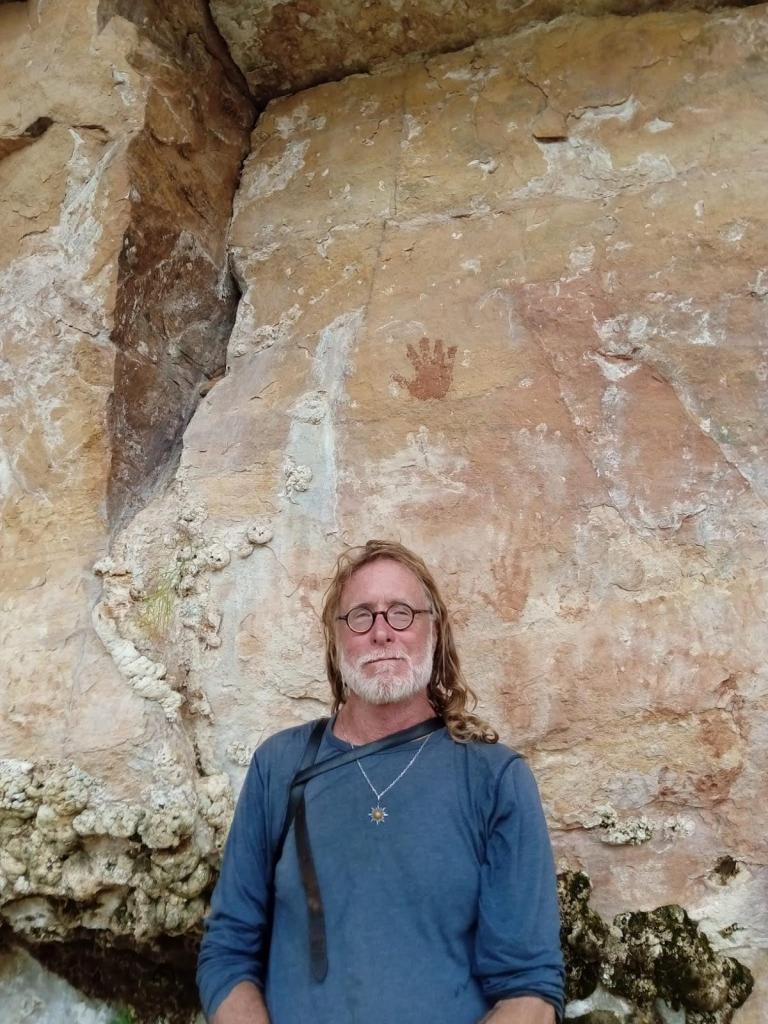
A biography, the graph of a life through time and space, seems to connote some kind of understandable chart (of words, not mathematical lines) that can be followed from birth to death. My own particular life, which is still being lived, has held so much misunderstanding, so much of what is not apparent that it is only through my literature that one can try to comprehend the reasons why I have lived the way I’ve lived and done the things i’ve done. But before you dive in, let’s get some basic facts down.
I was born prematurely on the hottest night of the year, at 11.30 p.m. on July 14, 1960 in Salt Lake City Utah, the fifth son of a World War II vet and his staunchly Mormon wife. Simple enough. We’re all born, prematurely or not. Some die after a day, like one of my brothers, who had also been born prematurely. My father was at a ballgame and it was my eleven year-old brother who drove my mother to the hospital. I somehow survived, though I had to stay in an human incubator for some time.
So there I was, another son when my mother had been hoping ever since 1949 to have a daughter. Bright red hair curled positively out of my head for the next two years, causing visiting relatives to remark of what a lovely girl my mother had, which was a cute joke that made me hide my head under one of my father’s Stetsons, not because I had any idea about the difference between being born a boy or a girl but because I didn’t like being fawned over and I felt, even at two, that it was phony.
My mother finally had her daughter five years later, the last of the brood, and I was then pretty much forgotten and left to my own devices as to how to deal with three big brothers, growing up in the their shadows and suffering through their name-calling : carrot-top for my hair, stub for my littler-than-theirs, and wit for my increasingly acerbic intelligence. All through my school years I felt the need to outperform them, and many teachers made me realize I had to outperform them, since all of us were rebellious with the authorities.
At the age of eighteen I had had enough of the pressure I was under, first to be a good little brother who’d grown taller than everyone else in the family, and second, to serve a mission, which was something ninety percent of the nineteen year-olds on the east side of Salt Lake did. There is a certain identity to being a Utahn, especially as my roots go back to the original pioneers. They crossed the prairie to, surprise ! get out of the United States, so they could continue their practice of polygamy, but there was no way I was going to blow two years of my life evangelizing for a religion I found rather silly. Golden plates, urim and thummim my eye. I found it hilarious that ol’ Joe Smith would put on round glasses, seer stones, and stick his head in a hat to find an English translation underneath lines of an incomprehensible language : his Book of Mormon. Personally, I had been wearing round glasses ever since I was eleven but that was the influence of John Lennon, and I’d already stuck my head in a hat and found only an anonymous darkness.
And so I escaped. I continued my education in the south of Utah, majoring in the sciences before being discovered by the English department after enrolling in a required class. Apparently I had a talent for reading good literature and writing about it in an original way. It was something I enjoyed. The dean then offered me a scholarship to change the bulk of my studies to literature, history, languages and philosophy, all wonderfully impractical, and it has been downhill ever since.
I never realized I was making a career choice in simply continuing to learn, to want to learn for the sake of learning and not try to find a niche within which to make a living. During my university years when summer came around I watered a golf course by night and golfed by day. Golf is another domain I needed to improve upon, it being so humbling, so difficult to attain a high standard of play, such a four-letter word, but still I golfed, trying not to curse. Summers came, summers went, I got my bachelor’s degree and put it in a frame.
Life in the United States might be fine, if you had no curiosity as to what was actually going on in the rest of the world. The problem was I did have curiosity, and time, and started traveling more and more around North America, around not only the United States but Canada and Mexico, on my thumb as if it were the easiest thing in the world, and it was. Jack Kerouac was right, the country was still a song and a dance back then. But I was still not satisfied, still young, and still with my life in front of me.
At the age of twenty-two I flew to Paris and then spent the better part of four years hitchhiking and working odd jobs around Europe, learning languages by listening to them, by speaking them, by letting them infuse into the vast emptiness of my hatless mind. I could tell you many things about how an national, rational identity can be simply washed away by allowing oneself to speak several languages, but I won’t. European languages, Hungarian apart, are a piece of cake compared to what was coming for me.
At the age of twenty-six, almost broke and yet unbroken, I finagled a fake communist-student I.D. in the then (and still) maverick land of Hungary, and managed to travel across the Soviet Union and China to hop on a boat to Japan. I had twenty dollars to my name upon arrival. They could have refused entry but I was shorthaired, cleancut, and wearing a schnazzy leather tie from Moscow. They let me right in. I managed to get work, my first, real, salaryman job in my life, teaching English at a private school.
In the almost three years I stayed in Japan I published my first two books, slim tomes they were, and went through a major reshuffling of my mind. It wasn’t just the language, something which you understand by listening to the silence between the lines, but the people, who were so darn polite and sophisticated one couldn’t help but simply observe and marvel how they arranged time and space on that extended archipelago. I could have stayed, but the fact was so many other westerners had arrived wanting the same experience I had, and the Education Ministry soon let it be known that they would only hire teachers with Master’s degrees, so I decided to return to Utah seven years after leaving and go back to school.
My Master’s is in English creative writing, still so impractical as to almost be a joke. Creative Writing ? What can you do with Creative Writing ? Well…write I suppose.
I returned to Japan, but this time only to say goodbye, and got on that boat back to China, where I spent all the money I had made in Alaska the summer I’d turned thirty traveling around the Middle Kingdom. Those were the days when you could get a three-month visa in Hong Kong, extend it three months in any Chinese town, then return to Hong Kong for another three-month visa. Those were the days when, if you decided to get off a train in any unknown village, the entire village would come and gawk at you as if you were the most exotic animal in the zoo.
After a year of this I had an even less sense of identity. The English language had become so rare that when I finally heard it again I had a hard time following it, as one might have trouble keeping to a trail that had become overgrown with the endemic plants of another language. I bought a shortwave radio, just to get more of it, and the English language came from none other than Radio Moscow. Not only was it clearly spoken, it was clear that revolution was in the air. I had been reeducated enough in the Chinese countryside. It was time to return to Europe the way I had left Europe, across the sprawling Eurasian continent by train.
I arrived in Moscow in the middle of it all. There were tanks in the streets. There was clamor and chaos and it was wonderful. I traded my Alaskan hoodie for a Red Army greatcoat. I traded my Converse All-Stars for a pair of Red Army boots. NOW I was ready to invade Europe once again.
Still yearning for comprehension amid incomprehension, I returned to Hungary to take on Hungarian, worked for an English language newspaper, taught in some businesses, and slowly let that strange tongue wrap its tongue around my ears. I must say that Hungary is the most exotically strange country in Europe. It’s almost as if Hungary, if it weren’t located where it was, were back in its southern Ural cradle, and the people, for all their subversive spirit, couldn’t quite comprehend where they had exactly ended up. I realized it was because the country was landlocked. It had no sea, unless we can consider Lake Balaton as a sea.
After a year or more of this I was beginning to feel their sense of displaced melancholy in my own being. I needed to get away. On a winter vacation to the land of Egypt, on the very first day of arriving in the Sinai I had my things stolen. An Israeli soldier-tourist gave me his military sleeping bag and I hiked to the top of Mount Sinai to ask the snow-covered African rocks what I should do. There was a refuge there, and inside were ten guys and one lady. The guys all had their sleeping bags, while the woman had a sheet. I was the last in, and the only spot was next to her. When her teeth started chattering I did what any gentleman would do : unzip my sleeping bag and wrap her close to me so we both could stay warm.
By and by she became my wife.
I left Hungary for France, for the countryside of France, for Normandy and its hedgerows, military cemeteries and cows. It was there I began writing Anti-Frontiers, a nostalgic look back at my native land and the joy of traveling it. I realized I was becoming domesticated, and it was only through recreating my lessons of travel that I could balance things between the idea of a stable home life and the desire to know what was beyond the front door. This has been my modus operandi ever since.
Our daughter was born a few years later. We got married and returned to Utah during my wife’s maternal leave, a generous three years that allowed me to feel Utahn again instead of some kind of stateless wanderer. We could have stayed but returned to France. By my thirty-something years I realized that there was now something called a future, a future not just for me but for my family, and living in France, in Europe, seemed better for my wife and daughter. We could always return to Utah when our next child came.
We returned to Normandy and I was hit with the same lack of employment as before. Certainly, I worked on my writing, the poetry of my book Some People, but I had to work, to get a job and make money for my family, so I went off to the big city of Paris and started teaching there. My family came the following year, but Paris and its environs are not for everybody. The pressure of the suburbs, of working with undocumented women and their pregnancies, of dealing with my farflung vacation plans instead of just going to grandmother’s house wore my lovely spouse down. We had a miscarriage one of those years, our son was born a few years afterward, but instead of returning to the United States for another three years my better half felt she couldn’t just take advantage of such an offer, so we stayed in the suburbs of Paris, wearing ourselves down to the point that she up and quit me, returned to the countryside, this time in Brittany.
The shock of it didn’t hit me until much later. I arranged a sabbatical year. I did have the right to it, the right to get some air, to, as the French say, changer les idées. This time it was to the southern hemisphere, where my autobiographical novel Gone Deep South came to light. The discovery of these new lands did revitalize my otherwise sad state, did strengthen my body against the elements as I was camping and hiking the entire year, and although I was pushing fifty, when I returned to Paris to start up again at the business school and university I decided I would put a halt to all idea of domesticity.
In this respect another autobiographical novel was created, An American (homeless) in Paris. Yes, I was « homeless », setting up a big tent on an abandoned golf course near where we had been living and continuing to work with business bigwigs in Paris, with postgraduates in Créteil. It was, I suppose, a compromise between living the outdoor life at the same time as making money for my family. The book won a prize in the United States and was eventually published there, while its translation has taken its time coming to light in the country of its birth.
By and by, however, this arrangement of mine was wearing thin on my employers. Whereas I began life in Paris as a bourgeois-bohemian, a bobo, I was now just a bohemian, my hair gone uncut and my clothes not of the suit-and-tie variety. The bigwigs didn’t mind. They liked my hours come to fill them in on the beauty of the planet as I had known it, the places I recommended for their August vacations, but, according to the British boss of the business school, this was not good for the image of his enterprise. It was also not good according to my ex-wife, who accepted me every other weekend so I could still be present in our childrens’ lives. Three years after our divorce we were becoming intimate again, and I created my first bilingual book, The Midwife/La Sage-Femme, to honor her work and life, but in my second youth (some call it a midlife crisis) I had taken up with a young parisienne, and when the shit hit the fan, when I told my ex truthfully of this, well, my days of easy living were soon to end.
I was banished from the family home and forced out of my job in Paris. To be honest I was more surprised by the latter, for I thought it was impossible to be fired from work that was pleasing both to me and the customer, the last of whom, the union delegate of Danone, got a lawyer for me to fight for my unjust dismissal. As for the former, I got no lawyer for the court my ex was dragging me to simply because I didn’t want to fight, simply because I loved her and my family and didn’t want to fight, believing ultimately in redemption. Silly me. I won the case in Paris. It took two years but I won, whereas in Brittany, well, I never thought of it as winning or losing because to me it wasn’t a game.
Thus began years of exile and return, of travel to parts of the planet I hadn’t experienced, to the Caucasus, Iran and the Silk Road, to Mongolia and especially Russia, and of writing bilingual books which I would sell in the metro of Paris to finance my continued travel and to give me a sense of worth. For this is what it has come down to, a sense of worth. I realize that what I have done and how I have lived, good and bad and ugly as it has been, is a unique life, something to be learned from and creatively written about. The life of an under-acknowledged writer can indeed be difficult, if you let it.
I didn’t want to let it. I still had responsibility to my family, creating Coming of Age/La Fleur de l’Âge to honor my children, and coming to Brittany in early 2020 to convince my son to continue his studies in the city of Rennes. My daughter, for her part, had already shown her brilliance and drive in higher education, but my son was more like his father, wanting to enjoy life. Of course, early 2020 was when we all became locked down with the Coronavirus, and soon after arriving in Rennes, again with no home, no apartment, there I was, locked down and sheltered under a bridge on the Vilaine. I fixed the place up, creating an outdoor studio apartment. I painted murals on the building across the way and under the bridge, built a fireplace for winter and ended up writing my first book straight into French, entitled Sous le Pont Laënnec.
This caught the attention of the Prix Goncourt recipient Yvon Le Men, who included me in his theater production of Les Epiphaniques and invited me to the literary festival of Les Étonnants Voyageurs in St Malo. It was a heady time. People from town, and even from out of town would come visit me under the bridge as if I were some kind of sage. The homeless would come, sometimes bothersome but mostly amazed that one of their kind could create such a place and have such success. Documentarists made a documentary, but it was Brut, an internet magazine of sorts, that made the difference, for the video they made went viral to the point that a government official came and informed me that I should be allowed to live in a « normal » studio and not this time-share with the occasional rat.
So here I am, back inside, trying my best to age open-eyed. It is beautiful out. It’s always beautiful outside, but the time has come to get the work of my life together, and with the help of my dynamic daughter I hope this web of literature will be a pleasing and learning experience for you.
Rennes, June 2025
 Chris Ames